
The venue is booked. The agenda is set. The speakers are confirmed. Transportation is the detail that holds all of it together — or doesn’t.
Corporate events fail at the margins. Not in the keynote and not in the catered lunch, but in the 20 minutes before the first session when three board members are still in a rideshare that has been rerouting for 15 minutes, and in the transfer between the conference venue and the evening dinner where the group dynamic that has been building all day gets fractured by split vehicles and confused departure logistics.
Transportation is the connective tissue of a corporate event. It is not the headline. It is not what anyone will comment on if it goes well. It is precisely what everyone will remember if it doesn’t.
This checklist is for the executive assistant, the operations director, the chief of staff, or the CEO who is responsible for a corporate event in Nashville and understands that the transportation element deserves the same level of structured planning as every other component of a high-quality event. It covers every stage of the planning process, from the initial assessment through to the post-event debrief, with the specific details that separate events where transportation is invisible from events where it becomes the story.
Before You Begin: The Assessment Questions
Every corporate event transportation plan begins with a set of assessment questions that determine the scope, the vehicle configuration, and the service format required. Answer these before any booking conversation happens.
How many attendees require ground transportation?
This is the foundational number. It determines vehicle count, vehicle type, and the complexity of the coordination required. An executive dinner for 8 guests has a fundamentally different transportation requirement than a two-day leadership summit for 60. Get an accurate headcount for each transportation moment in the event, not just the total event attendance.
Where are they arriving from and departing to?
Nashville corporate events draw attendees from multiple origins: local Nashville executives arriving from Green Hills, Belle Meade, and Brentwood; out-of-town executives arriving at BNA on commercial flights; and private aviation clients arriving at Signature Flight Support or Jet Aviation at BNA’s FBO terminals. Each origin point has different timing requirements, different vehicle staging logistics, and different service protocols. Map the origins before configuring the transportation plan.
What is the full movement map of the event?
A corporate event is not a single transfer. It is a series of movements: airport arrivals, hotel-to-venue transfers, intra-day movements between sessions or sites, evening dinner transfers, and airport departures. List every movement before contacting a transportation provider. The full movement map is what determines whether a single vehicle on an hourly basis covers the requirement or whether a coordinated fleet deployment is needed.
What is the timeline for each movement?
For each movement in the map, identify the latest acceptable arrival time, the realistic departure time, and the buffer required for the movement to be reliable rather than hopeful. Corporate event transportation that is planned to the minute on paper but has no time buffer built in fails predictably under real-world conditions.
What is the standard your event requires?
A corporate event that is bringing in investor-level guests, board members, or C-suite executives from outside Nashville has a specific transportation standard requirement. The vehicle that picks up a potential acquisition partner from BNA is part of the first impression your company makes on that individual. Calibrate the vehicle selection to the professional level of the engagement.
The Planning Checklist: Stage by Stage
Stage 1: Initial Assessment and Provider Selection
Define the full movement map before contacting providers. Write out every transfer the event requires, from the first airport arrival to the last departure, with estimated times and passenger counts for each movement. Providers who receive a complete movement map can give you an accurate quote and flag logistical conflicts before they become day-of problems. Providers who receive vague requests give you vague solutions.
Select a single provider for the full event where possible. Using multiple transportation providers across a single corporate event creates coordination complexity that compounds under pressure. A single provider with full visibility of the event’s movement map can coordinate vehicle staging, driver briefings, and timing adjustments across the entire event. Multiple providers create handoff points where communication breaks down.
Verify the provider’s fleet configuration. Confirm that the vehicles available match the event requirement. A provider with a strong individual executive transfer portfolio is not automatically equipped for a 40-person group movement. Ask specifically about vehicle count, vehicle type, and the maximum group configuration available.
Confirm the provider’s corporate event experience. Corporate event transportation is a different discipline from standard executive transfers. It requires multi-vehicle coordination, real-time communication between drivers, a single point of contact who monitors the full event and adjusts as it evolves, and the ability to absorb the inevitable schedule changes that every corporate event generates. Ask directly about prior corporate event experience and references.
Establish a single point of contact on both sides. Every corporate event transportation arrangement should have one named contact at the transportation provider and one named contact on the event side. All communication flows through these two points. Multi-channel communication across multiple event staff and multiple drivers is the primary cause of corporate event transportation failures.
Stage 2: Airport Arrivals and Departures
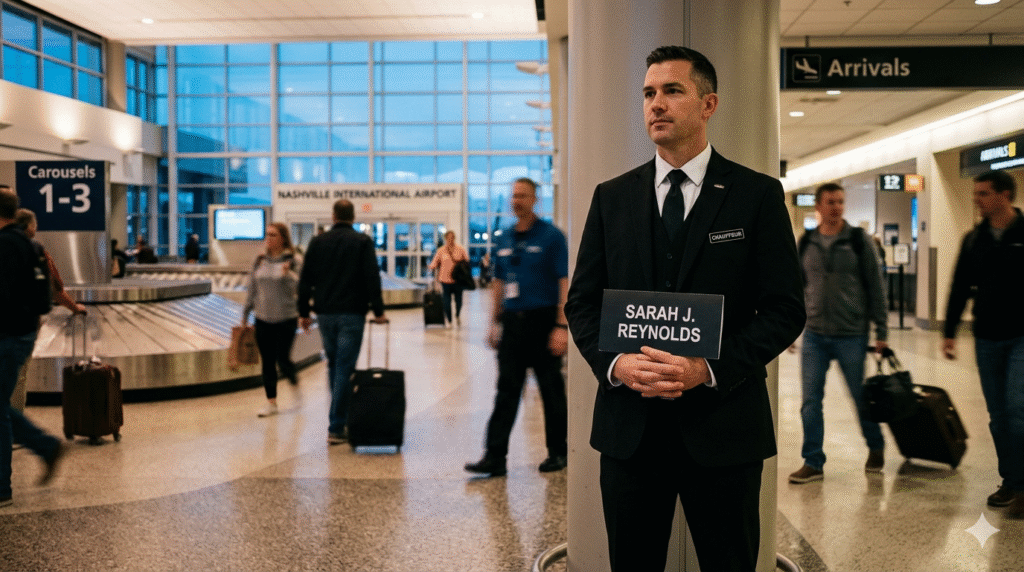
Airport arrivals are the highest-risk movement in any corporate event transportation plan. Flight delays, gate changes, baggage claim variability, and the sheer density of BNA arrivals during a peak window create conditions where a plan that looks clean on paper becomes chaotic without the right protocols in place.
Build a master arrival manifest. For every attendee requiring airport pickup, capture: full name, flight number, airline, scheduled arrival time, terminal, and mobile number. This manifest is the driver’s operational document. It should be updated in real time as flight information changes.
Implement flight tracking for all arrivals. STS Nashville monitors flight status in real time for all airport transfer clients. Flight delays, early arrivals, and gate changes are absorbed into the chauffeur’s timing automatically rather than requiring the event coordinator to manage the information flow. Confirm that your transportation provider does the same.
Configure vehicle staging to the actual arrival pattern. If 12 executives are arriving within a 90-minute window across multiple flights, the vehicle staging plan needs to account for the overlap. A single vehicle on a single loop cannot absorb simultaneous arrivals without creating wait times that set the wrong tone before the event has begun. Plan vehicle count to the arrival density, not to the total headcount.
Separate FBO arrivals from commercial terminal arrivals. Private aviation clients arriving at Signature Flight Support or Jet Aviation require a completely separate staging protocol. The FBO arrival process, tarmac staging, and meet-and-greet logistics are fundamentally different from commercial terminal pickups. Confirm that your provider’s FBO ground transportation protocol covers this distinction explicitly.
Plan departures with the same rigor as arrivals. Departure logistics receive less planning attention than arrivals in most corporate events and fail more visibly when they go wrong. A board member who misses their flight because the departure vehicle was late is not a minor event consequence. Build departure manifests with the same detail as arrival manifests, and build in a time buffer that accounts for post-event schedule drift.
Stage 3: Hotel and Venue Transfers
Hotel-to-venue and venue-to-hotel transfers are the highest-volume movement category in most corporate events, and they are the movements most frequently underestimated in complexity.
Confirm hotel loading zone protocols in advance. Nashville’s major corporate event hotels have specific loading zone configurations, staging time limits, and security protocols that affect vehicle arrival and departure logistics. Confirm these with the hotel’s events coordinator before the event, and brief your transportation provider specifically on the protocols that apply.
Stagger departure waves for large groups. Moving 40 executives from a hotel lobby to a venue in a single departure wave creates a lobby congestion problem that compounds across the entire event schedule. Plan departure waves in groups of 10 to 12, staggered by 8 to 10 minutes, with vehicle assignments communicated to attendees in advance. The group arrives at the venue in a continuous flow rather than a single overwhelming surge.
Assign vehicles to specific attendee groups rather than operating a free pool. A free vehicle pool, where any attendee boards any available vehicle, creates confusion, delays departures as vehicles wait for stragglers, and loses the ability to guarantee that specific attendees travel together as planned. Assign specific vehicles to specific attendee groups and communicate assignments clearly.
Position a logistics coordinator at the hotel departure point. For large group movements, a logistics coordinator at the hotel loading area who manages boarding, communicates with drivers, and monitors the departure sequence is the difference between a smooth 15-minute departure operation and a 45-minute ordeal. This is not an optional role for events above 20 attendees.
Account for the post-session energy dynamic. The vehicle configuration that works for a morning hotel-to-venue transfer, when attendees are focused and relatively quiet, may not be the right configuration for an evening dinner departure when the energy is higher, the conversation is flowing, and the group dynamic is at its most social. The Jet-Style Sprinter handles both modes with equal facility, but the seating and staging configuration may differ.
Stage 4: Intra-Day and Multi-Venue Movements
Corporate events that span multiple venues, that include off-site sessions, or that involve site visits and facility tours present a category of transportation complexity that standard event planning checklists often miss entirely.
Map every intra-day movement as a separate transfer, not as a footnote. A morning session at a Brentwood corporate campus, a working lunch at a Green Hills restaurant, and an afternoon session back at the main venue are three separate transfers with three separate logistics requirements. Treat them as three separate transfers in the transportation plan rather than as a single continuous movement with the vehicle “just waiting.”
Confirm vehicle availability for the full event day. For events that require intra-day movements, vehicles need to be reserved on an hourly basis for the full event day rather than on a per-transfer basis. STS Nashville’s hourly chauffeur service is the correct format for full-day corporate event coverage. Per-transfer bookings create availability gaps between movements that the event cannot absorb.
Brief drivers on the full day’s itinerary, not just their immediate movement. A driver who knows only their immediate assignment cannot make the real-time judgments that multi-venue event days require. Brief all drivers on the full day’s movement map, the overall event schedule, and the flexibility windows within each transfer. A driver who knows the afternoon session ends at 4:30pm and the dinner reservation is at 6:30pm at a downtown venue can make routing decisions that a driver who only knows “pick up at 5:15pm” cannot.
Designate a lead driver for multi-vehicle days. On events requiring three or more vehicles operating simultaneously, designate a lead driver who serves as the primary point of contact between the transportation provider and the event coordinator. All real-time adjustments flow through the lead driver rather than through simultaneous communications with multiple drivers.
Build a 20-minute buffer into every intra-day transfer. Corporate event schedules drift. Sessions run long. Conversations continue past the formal end of the agenda. A 20-minute buffer built into every intra-day transfer timing absorbs this drift without cascading into a transportation failure at the next movement.
Stage 5: Evening Events and Entertainment Transportation
The evening portion of a corporate event presents a specific set of transportation challenges that differ from daytime movements in tone, timing variability, and the importance of arrival presentation.
Venue arrival presentation matters more in the evening. A corporate dinner at a Nashville restaurant or private venue is a social occasion as much as a business one. The vehicle that delivers your attendees communicates something about the event and the organization behind it. For evening events where the guest list includes board members, investors, or significant external partners, vehicle selection should reflect the occasion.
Plan for flexible departure timing. Evening event departures are the least predictable movement in any corporate event. Dinners run long. Conversations continue at the table. The formal end time and the actual departure time frequently diverge by 30 to 60 minutes. Build this variability into the departure plan with a vehicle and chauffeur who are available for the full evening window rather than a hard-scheduled pickup that creates pressure on the event’s natural conclusion.
Consider a hospitality vehicle for the evening. For executive groups that will be moving between a dinner venue and an evening social event, a single hospitality vehicle on an hourly basis for the full evening eliminates the multiple-booking complexity and keeps the group together in a cabin that supports the social dynamic of the evening. The Jet-Style Sprinteris the natural choice for this format: a cabin that is itself a social environment, not just a means of getting from one venue to another.
Coordinate departures with the venue events team. Nashville’s major event venues have specific protocols for post-event vehicle staging that vary significantly by location. A venue that accommodates 10 vehicles in a single staging area has different departure logistics than a venue that requires vehicles to stage on a side street and be called in individually. Confirm staging protocols with the venue events team and brief your transportation provider specifically.
Stage 6: VIP and Speaker Transportation
VIP guests, keynote speakers, and board members require a transportation protocol that is separate from the general attendee plan and held to a higher standard of individual attention.
Assign a dedicated vehicle and chauffeur to each VIP. VIP transportation is not pool transportation with a nicer vehicle. It is a dedicated vehicle, a dedicated chauffeur, and a service protocol that is calibrated specifically to that individual’s preferences, schedule, and requirements. The Cadillac Escalade for solo VIP transfers and the Jet-Style Sprinter for VIP groups with staff or aides are the standard STS Nashville configuration for this role.
Brief VIP chauffeurs on individual preferences in advance. Before a VIP chauffeur assignment, capture the individual’s preference for: conversation vs. silence, preferred temperature, preferred route if known, any specific requirements for the vehicle preparation, and any schedule sensitivities that affect timing. A VIP who prefers a silent transfer and receives a chatty driver has had a poor experience before they have attended a single session of the event.
Build VIP schedules with double the standard buffer. A keynote speaker whose flight is delayed, whose green room preparation runs long, or whose post-session meet-and-greet extends beyond its scheduled time cannot be rushed to the next engagement without consequence. VIP transfer windows should carry double the standard timing buffer, and the driver should be briefed to absorb schedule drift without communicating stress to the passenger.
Coordinate VIP departures directly with the VIP’s assistant or chief of staff. For board members, keynote speakers, and other significant VIPs, departure coordination should happen through the VIP’s own operational support rather than through general event logistics. A chief of staff who controls the VIP’s schedule and communicates directly with the designated driver delivers a fundamentally more reliable departure experience than routing the communication through general event coordination.
Stage 7: Communication and Day-Of Operations
The best transportation plan in the world underperforms without a communication protocol that makes real-time coordination possible across all parties on the event day.
Create a transportation information sheet for attendees. Every attendee who requires transportation should receive, before the event, a one-page transportation reference that includes: their assigned vehicle, their chauffeur’s name and mobile number, pickup locations for each movement, scheduled pickup times, and the event coordinator’s direct contact for transportation questions. This document eliminates the majority of day-of transportation queries before they become logistics problems.
Establish a dedicated event day communication channel. A group message thread that includes the event coordinator, the STS Nashville event point of contact, and all assigned drivers provides a real-time communication backbone for the event day. Schedule changes, flight updates, and timing adjustments can be communicated instantly across all parties rather than through a sequence of individual phone calls.
Conduct a morning confirmation call on event day. Before the first transfer of the day, a 10-minute call between the event coordinator and the STS Nashville event contact to confirm all manifests, review timing, and flag any overnight developments — flight changes, schedule adjustments, additional requests — sets the operational baseline for the day and surfaces any issues before they affect a live movement.
Designate a transportation point of contact for attendees on the day. Attendees who have questions, need to adjust their pickup, or miss a scheduled departure should have a single named contact on the event staff to call. This person has direct communication with the transportation provider and can resolve individual issues without escalating to the general event coordination chain.
Stage 8: Post-Event Review
Debrief the transportation element within 48 hours. The details of what worked and what didn’t are sharpest immediately after the event. A structured debrief with the transportation provider within 48 hours captures the specific improvements and confirms the elements that should be replicated for the next event.
Capture individual attendee feedback on transportation. For recurring corporate events, attendee feedback on the transportation experience provides the most accurate data for improving the plan next time. A single question in the post-event survey — “How would you rate your ground transportation experience?” with a free-text option — captures the specifics that general logistics reviews miss.
Establish a standing arrangement if the event recurs. For annual or quarterly corporate events in Nashville, a standing arrangement with STS Nashville that locks in vehicle availability, pricing, and chauffeur assignments for future dates eliminates the re-procurement process and ensures that the service relationship deepens with each event rather than beginning from scratch each time.
STS Nashville Corporate Event Services
STS Nashville provides corporate transportation for Nashville’s full corporate event calendar, from intimate board dinners for 8 to multi-day leadership summits requiring coordinated fleet deployment.
Our corporate event fleet includes the Jet-Style Mercedes-Benz Sprinter for group movements and hospitality transport, the Cadillac Escalade for VIP and executive individual transfers, and extended fleet options for large-group requirements. All vehicles are 2022 or newer, detailed before every booking, and operated by chauffeurs with specific corporate event briefing protocols.
For multi-day events, recurring annual events, and corporate clients with ongoing Nashville transportation requirements, STS Nashville provides dedicated account management, consolidated monthly billing, and standing vehicle arrangements that remove the re-booking friction from every event cycle.
Contact us to discuss your event’s specific requirements and receive a custom transportation plan tailored to your movement map, your attendee profile, and your event standard.
Request a Corporate Event Transportation Quote → Call 24/7: (615) 480-4629

