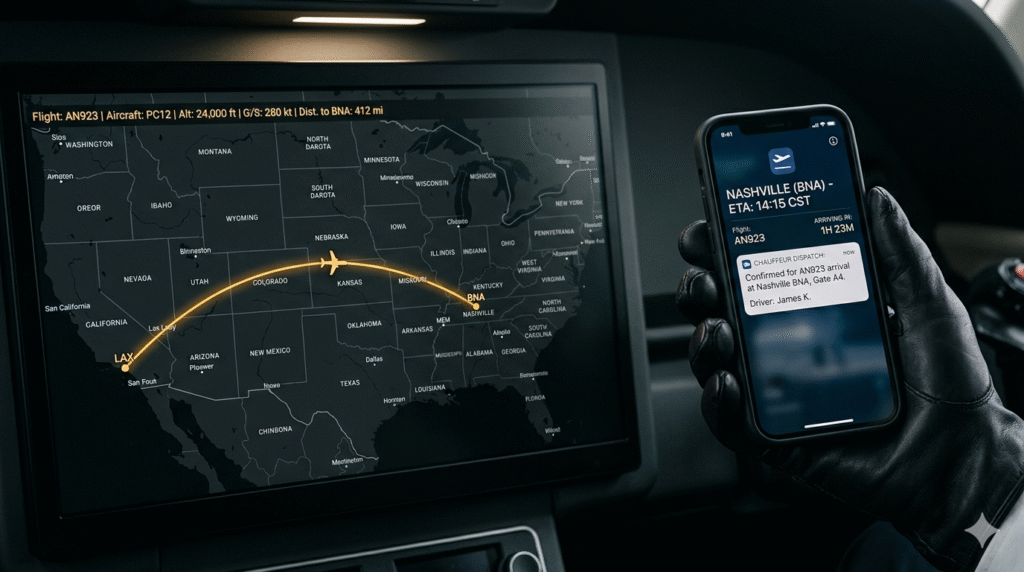
Most car services say they track flights. Here is exactly what that means at STS Nashville, why it matters more than most clients realize, and what happens when the system works the way it should.
There is a specific kind of stress that belongs exclusively to the airport pickup experience, and it is familiar to anyone who has flown commercially with any regularity.
You land. You taxi to the gate. You collect your bags. You walk to arrivals and look at your phone. The car you booked is either there, circling, delayed, or nowhere. You exchange texts with a driver who is navigating the pickup zone while you navigate the arrivals hall, and for a period of somewhere between five and twenty-five minutes, two people who need to be in the same place are trying to find each other in one of the most logistically complex environments in any city.
For a leisure traveler, this is an inconvenience. For a Nashville executive arriving from a board meeting in New York, a due diligence visit in Chicago, or a red-eye from the West Coast, it is something more than that. It is friction at exactly the moment when the absence of friction matters most.
Flight tracking, done properly, eliminates this experience entirely. Not reduces it. Eliminates it.
This post explains exactly how STS Nashville’s flight tracking system works, what it covers that standard car service tracking does not, and why the difference between passive tracking and active coordination is the difference between a car service that says it tracks flights and one that actually uses that information to change what happens on the ground.
What Most Car Services Mean When They Say They Track Flights
It is worth being precise about this, because the phrase “we track your flight” has become standard language in the executive transportation market and it covers a very wide range of actual practice.
At the minimal end, flight tracking means that a dispatcher checks the flight status on a consumer app at some point before the scheduled pickup time and adjusts the driver’s departure if the delay is obvious and significant. This is reactive tracking. It responds to information that is already visible and already late in the adjustment window. A flight that lands 45 minutes early on a day when the dispatcher checked the status an hour before scheduled arrival and found no delay is a flight the driver is not ready for.
At the intermediate level, flight tracking means the company uses a real-time flight data service that monitors the flight from departure and sends alerts when status changes. This is better than consumer app checking, but it is still only as good as the human response to the alerts. If the alert fires at 11pm and nobody acts on it until the morning briefing, the information arrived in time and the response didn’t.
At the level STS Nashville operates, flight tracking is an active, integrated operational protocol that connects real-time flight data to the chauffeur’s timing, the vehicle’s positioning, and the client’s experience from the moment they board their outbound flight to the moment they reach their Nashville destination. It is not a feature that runs in the background. It is a core operational discipline that shapes every airport transfer booking.
The STS Nashville Flight Tracking Protocol: Step by Step
Step 1: Flight Information Collection at Booking
The protocol begins at the time of booking. When a client reserves an airport transfer with STS Nashville, we collect the full flight details: airline, flight number, origin city, scheduled departure time, and scheduled arrival time at BNA. For clients connecting through another city, we collect the connecting flight information as well.
This information is not collected as a formality. It is the operational foundation of everything that follows.
Step 2: Active Monitoring from Departure
STS Nashville begins active flight monitoring from the moment the client’s aircraft departs its origin city, not from the scheduled arrival time at BNA. This distinction matters more than it initially appears.
A flight that departs 20 minutes late from New York has already altered the BNA arrival time before the aircraft has entered Tennessee airspace. A flight that departs on time but encounters air traffic control holds over the Southeast will arrive late in a pattern that is visible in the flight data well before the aircraft reaches Nashville. Monitoring from departure means STS Nashville has the maximum available window to absorb any changes in the client’s arrival time.
For connecting flights, monitoring begins with the first leg. A client connecting through Atlanta whose first flight is delayed has a high probability of missing their connection, which creates a cascade of arrival time uncertainty that a chauffeur operating from the original booking time cannot navigate without active monitoring of the full itinerary.
Step 3: Real-Time Data Integration
STS Nashville uses professional-grade flight tracking data, the same category of real-time aviation data used by FBO operators, private aviation coordinators, and airline operations centers, rather than the consumer-facing flight status services that reflect only what the airline chooses to publish in its official data feed.
The difference matters because airline-published flight status data has a latency and a selectivity that professional aviation data does not. An airline may not update its official arrival estimate until the aircraft is already on approach. Professional flight data reflects actual aircraft position, speed, altitude, and projected arrival time continuously, allowing STS Nashville to calculate a precise updated ETA long before the airline’s app has registered any change in status.
Step 4: Chauffeur Timing Adjustment
When the flight data indicates a change in arrival time, the chauffeur’s pickup timing adjusts in real time. This is the operational step that separates a flight tracking system from a flight monitoring system.
Monitoring tells you when the flight has changed. Tracking adjusts the ground operation in response.
For an early arrival, the chauffeur departs earlier than the original schedule to ensure the vehicle is staged and ready when the client walks out of baggage claim rather than five minutes after. For a delay, the chauffeur’s departure is adjusted to avoid unnecessary wait time while maintaining the buffer required to be present before the client needs the vehicle.
The client does not need to call, text, or manage this adjustment. It happens automatically, invisibly, and correctly.
Step 5: Terminal and Gate Confirmation
BNA is a straightforward airport by major city standards, but it has multiple terminals and arrival areas that create a meaningful difference between a chauffeur staged in the right place and one staged in the wrong one. STS Nashville’s tracking protocol confirms the specific terminal and gate assignment as the aircraft approaches Nashville, ensuring the chauffeur’s staging position matches the client’s actual arrival point rather than a default assumption from the booking.
For clients arriving on flights that have changed gates, been diverted to an alternate terminal, or landed at an unexpected position on the airfield, this confirmation step is what prevents the five-minute “where are you?” text exchange that undermines the entire point of a professional pickup.
Step 6: The Meet and Greet
STS Nashville chauffeurs do not wait in the general pickup zone and rely on the client to navigate their way to the vehicle. They are positioned at the appropriate arrivals point with the client’s name displayed, present before the client exits the secured area, and ready to assist with luggage, direct the client to the vehicle, and begin the transfer without any logistical pause between landing and departure.
For clients who have just completed a long flight, a red-eye, or a particularly demanding day of travel, the absence of any coordination conversation at arrivals is not a small thing. You land, you exit, your name is there, your vehicle is ready, and the transition from aircraft to Nashville destination is seamless in a way that only happens when the ground operation has been running in preparation since your wheels left the origin city.
FBO Arrivals: A Different Protocol for Private Aviation
For STS Nashville clients arriving on private aircraft at Signature Flight Support or Jet Aviation at BNA, the flight tracking protocol operates in a fundamentally different environment and with a fundamentally different level of integration.
Private aviation tracking uses tail number monitoring rather than commercial flight number tracking. The aircraft’s tail number is filed with STS Nashville at booking, and our system monitors the aircraft’s departure, routing, and estimated arrival at BNA’s FBO terminal continuously from the moment the flight plan is filed.
The FBO arrival protocol adds a coordination layer that commercial terminal arrivals do not require. STS Nashville communicates directly with the FBO operator before the aircraft lands to confirm ramp positioning, coordinate vehicle staging at the appropriate tarmac access point, and ensure the Jet-Style Sprinter or Escalade is positioned precisely where the aircraft will park rather than waiting at the FBO entrance.
For private aviation clients, the standard of arrival is that the vehicle is present at the base of the airstairs before they have finished their post-flight conversation with the flight crew. The cabin is prepared to specifications confirmed before departure. The chauffeur is at the door, not approaching it.
This is not the standard a commercial terminal pickup can replicate, and it is not the standard STS Nashville attempts to replicate at the commercial terminal. It is the private aviation standard, applied to the ground, for clients whose most recent reference point is a private aircraft cabin.
Our FBO and private aviation ground transportation service covers both Signature Flight Support and Jet Aviation at BNA with this protocol on every booking.
What Happens When Things Go Wrong
Flight tracking is most visibly valuable not when flights arrive on time, but when they don’t. The scenarios that test the system are worth walking through specifically, because they are the scenarios that define whether a car service’s tracking capability is real or nominal.
The Significant Delay
A Nashville executive’s flight from Los Angeles is delayed three hours at LAX due to a mechanical issue. The original BNA arrival of 9:45pm becomes a projected 12:45am arrival.
Without active flight tracking, the chauffeur arrives at BNA at 9:30pm, waits, eventually receives a call or text from a frustrated client somewhere over the Midwest, and scrambles to adjust. The client lands at 12:45am to a chauffeur who has been at the airport for three hours, is tired, and has been reactive throughout the evening.
With STS Nashville’s protocol, the delay is identified when it registers in the departure data at LAX, hours before the aircraft lands. The chauffeur’s timing is adjusted from the original schedule immediately. By the time the client lands at 12:45am, the chauffeur has arrived at BNA at 12:30am, fresh, prepared, and positioned precisely where the client will exit. The client’s experience of the delay is contained to the airport in Los Angeles. It does not follow them to Nashville.
The Early Arrival
A client’s flight from Chicago departs 25 minutes early and, with favorable tailwinds, arrives at BNA 35 minutes ahead of the scheduled time. Under the original schedule, the chauffeur was not due to leave for BNA for another 40 minutes.
Without active tracking, the client arrives at baggage claim, waits, and sends a message to a driver who is still at home or staged elsewhere in the city. The earliest arrival in a long day ends with a wait at the airport that shouldn’t exist.
With STS Nashville’s protocol, the early departure registers immediately in the flight data and the chauffeur’s departure time adjusts accordingly. The client may still arrive before the vehicle in an extreme early arrival scenario, but the window is measured in minutes rather than in the length of time it takes a driver to get from wherever they are to the airport.
The Missed Connection
A client connecting through Charlotte misses their connection due to a delayed first leg. They are rebooked on a flight that arrives at BNA three hours later than the original itinerary.
Without comprehensive itinerary tracking, the car service knows only the original BNA flight number and arrival time. When that flight lands without the client on it, the system has no information and no protocol for what comes next.
STS Nashville’s protocol covers the full itinerary. When the first leg delay makes the connection probability low, the monitoring flags the risk. When the rebooking happens, the new flight information updates the arrival expectation. The chauffeur’s timing adjusts to the new arrival, and the client, already dealing with the frustration of a missed connection and a rebooked itinerary, does not also have to manage a ground transportation situation.
The Diversion
Rare, but worth covering because it is the scenario that completely defeats a tracking system that operates only on the filed flight number. An aircraft diverted from BNA due to weather to an alternate airport creates an arrival situation that has no relationship to the original booking.
STS Nashville’s use of real-time aircraft position data rather than flight-number-based status tracking means a diversion is visible as it happens. The aircraft’s departure from the BNA approach path toward an alternate airport is an event in the position data, not a status update that may or may not be published in the airline’s official feed. The ground response begins while the situation is still developing, not after the client has landed somewhere unexpected and is trying to communicate a new plan.
Why Flight Tracking Is Inseparable from the Nashville Airport Transfer Experience
The broader point behind all of this is one that STS Nashville’s Nashville airport transportation service is built around: the airport transfer is the highest-stakes moment in the ground transportation relationship.
It is the moment when the client is most tired, most time-sensitive, and least equipped to manage logistical variables. It is the moment when the value of a professional service is most clearly demonstrated or most clearly failed. And it is the moment where the gap between a rideshare app and a professional chauffeur service is widest, because the rideshare app’s response to flight uncertainty is to ask the client to manage it manually while the professional service absorbs it invisibly.
Flight tracking done properly is not a technology feature. It is a service philosophy. It reflects a fundamental decision about who is responsible for managing the complexity of air travel variability: the client, or the ground transportation provider.
At STS Nashville, that decision was made at the founding of the company. The client is never responsible for managing the ground logistics of their own arrival. That responsibility belongs to us, it is exercised from the moment the aircraft departs, and it is discharged when the client is in the vehicle and moving toward their Nashville destination.
Everything in between is ours to handle.
The Full Airport Transfer Experience
Flight tracking is the operational backbone of the STS Nashville airport transfer, but it is one component of a complete arrival experience that covers every element of the journey from aircraft to destination.
For commercial terminal arrivals at BNA, the complete experience includes real-time flight monitoring from departure, automatic timing adjustment for all schedule changes, terminal and gate confirmation, chauffeur positioning at the appropriate arrivals point before the client exits the secured area, name card meet and greet, luggage assistance, and a prepared cabin with preferred specifications confirmed at booking.
For FBO arrivals at Signature Flight Support and Jet Aviation, the complete experience includes tail number monitoring from flight plan filing, direct coordination with the FBO operator, tarmac-level vehicle staging at the aircraft’s parking position, cabin preparation to the client’s specifications, and the standard of arrival that private aviation clients carry as their reference point.
For both arrival types, the experience connects directly to whatever follows. A client arriving at BNA for a full day of Nashville meetings can move from the aircraft to a prepared Jet-Style Sprinter cabin where the day’s first working session is already possible. A client arriving for a corporate event can be delivered directly to the venue with their transportation coordinator briefed on the event’s movement schedule. A client arriving home after a long week of travel can be delivered to their Belle Meade, Green Hills, or Brentwood address in a cabin that has been a decompression room since wheels-down.
The flight tracking system makes all of this possible. The service philosophy makes it worth building.
Book Your Nashville Airport Transfer
STS Nashville provides airport transportation for commercial BNA arrivals and departures and FBO ground transportation for private aviation clients at Signature Flight Support and Jet Aviation. All bookings include our complete flight tracking protocol at no additional charge.
For standing airport transfer arrangements, corporate account billing, and dedicated chauffeur assignments for frequent BNA travelers, contact us to discuss a custom arrangement tailored to your travel schedule.
Book Your Airport Transfer → Call 24/7: (615) 480-4629